
CeraVe AM Facial Moisturizing Lotion SPF 30 Reviews: What Users Say
CeraVe AM Facial Moisturizing Lotion SPF 30 reviews land mostly positive, and the reason is simple: it’s a lightweight daily moisturizer with broad-spectrum SPF 30, niacinamide, and ceramides at a drugstore price.
The catch is the finish. On dry or normal skin it sits well under makeup. On oily skin it can look shiny within an hour, and it isn’t water-resistant, so a sweaty day or a swim means you’ll need to reapply or switch products.
Most complaints trace back to one of two things: the white cast some people notice if they apply the full recommended amount, or pilling when it’s layered over a serum that hasn’t fully dried.
If you have dry or normal skin and wear makeup on weekdays, this is a straightforward buy. If you’re oily, acne-prone, or spend the day outdoors, treat it as an indoor, low-sweat option and keep a separate water-resistant sunscreen for everything else.
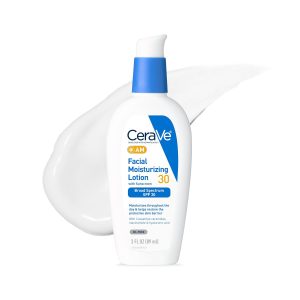
What CeraVe AM Facial Moisturizing Lotion SPF 30 reviews agree on
- SPF 30, broad spectrum. That’s the FDA’s minimum “broad spectrum” threshold, and it covers UVA and UVB. It’s not enough for a full day at the beach. For errands, a commute, or a desk near a window, it holds up. For a hike or a long lunch outside, reapply or pick something higher.
- Key ingredients: ceramides (1, 3, 6-II), niacinamide, hyaluronic acid, and zinc oxide plus homosalate and octinoxate as UV filters. The ceramides and niacinamide are why dry and reactive skin types tend to tolerate it.
- Texture: lotion, not cream. Absorbs in about 1-2 minutes on most skin types, per user reports. Give it that long before makeup, or foundation pills on top.
- Finish: dewy on dry skin, shiny on oily skin. Many reviewers with oily skin say they set it with powder or use it only in winter. If you’re oily and shopping in July, this is the detail that decides it.
- Not water-resistant. No water-resistance claim on the label, so sweat and swimming strip it fast. Reapply after any real sweating, not just after swimming.
- Price: inexpensive relative to the alternative, which works out to a small fraction of the cost per ounce.
Why the finish splits opinion
The shine comes from the formula’s emollients and the UV filters themselves. Homosalate and octinoxate are organic filters that need to be dissolved in an oil phase — that’s how they spread evenly across your skin. The trade-off is that this oil phase stays on the surface, and on skin that already produces its own oil, it reads as greasy within the first hour.
CeraVe solves part of this with niacinamide, which appears in the formula at a level that helps support the skin barrier. It doesn’t mattify. Nothing in this lotion is designed to control shine, and that’s the catch: how shiny you look depends entirely on your own sebum output, which you can read off your face about an hour after applying. If your T-zone is already oily at that check, this product will feel heavy to you.
The ceramides are the other reason people keep buying it. Ceramides are lipids your skin makes naturally, and they sit in the outer layer to hold water in. A moisturizer with ceramides doesn’t replace what you make — it tops up the supply while the sunscreen filters do their job above it.
If you want the exact UV filter list and concentrations, they’re printed on the CeraVe product page and on the drug facts panel of every bottle.
When this lotion isn’t the right pick
One lead point: the simple “it works for most people” answer breaks down fast once your skin type, climate, or routine changes.
| Situation | What changes | What to do instead |
|---|---|---|
| Very oily skin | Looks shiny in 1 hour | Use a gel SPF, save this for winter |
| Swimming or heavy sweating | No water resistance | Switch to a water-resistant SPF 50 |
| Active acne breakouts | Heavy base may clog pores | Try a lighter, non-comedogenic SPF |
| Sensitive or reactive skin | Fragrance-free, but filters can sting | Patch test on your jaw first |
| Full day outdoors | SPF 30 fades in about 2 hours | Reapply every 2 hours or use SPF 50 |
| Wearing full makeup | Pills under some foundations | Wait 3-5 minutes before makeup |
Two of these rows get misread, and both cost you money.
Oily skin in a humid summer is the first. A gel SPF isn’t a lesser product; it’s the correct one for July, and this lotion is the correct one for January. Buy the gel now and you won’t need to replace this bottle, just rotate it.
The second is sensitive skin. “Fragrance-free” tells you what was left out, not what is inside. Chemical filters sting some people and mineral ones sting others, so the label can’t predict which group you’re in. Patch test the jaw for three nights before you commit it to your whole face.
If you’re outdoors for a full day, no SPF 30 in this format survives it. Reapply, or start with SPF 50 and still reapply.
If none of these rows describe you, this lotion is a reasonable daily pick.
How to use it properly
- Start with a clean, dry face. Wash with a gentle cleanser and pat dry. Wait about 1 minute so your skin isn’t damp — damp skin dilutes the lotion and it spreads unevenly.
- Measure the right amount. Use about a nickel-sized amount, roughly 1/4 teaspoon, for your whole face and neck. Less than that and you’re getting well under SPF 30.
- Dot and spread, don’t rub hard. Place five dots — forehead, each cheek, nose, chin — then smooth outward. Rubbing aggressively breaks the film that makes the SPF work.
- Wait 2-3 minutes before anything else. The lotion needs to set. If you apply makeup right away, it pills and the SPF layer gets disturbed.
- Don’t forget the neck and ears. These are common skin cancer sites. Use whatever’s left on your fingers after the face.
- Reapply every 2 hours outdoors. Indoors near a window, once in the morning is usually enough. Outdoors, the clock starts when you step outside.
- Check the expiration date. Most sunscreens lose effectiveness after about 3 years, or sooner if stored in a hot car. If there’s no date, write the purchase month on the bottle.
Mistakes that ruin the result
- Using too little. Most people apply about half the tested amount, which drops real-world protection well below SPF 30. A quarter teaspoon for the face is the number to remember. If you use a moisturizer with SPF instead of a dedicated sunscreen, you need the same quarter teaspoon of that product, which is far more than most people would ever smooth on as a moisturizer.
- Skipping reapplication outdoors. SPF 30 isn’t a full-day shield. Two hours in direct sun and you’re unprotected, no matter what the bottle says. Indoors near a window, once in the morning is usually enough. On a bright day outside, set a timer.
- Layering it over a rich night cream. The two products fight each other and the SPF sits unevenly. Use a light serum underneath instead. If your skin is dry enough to need the heavy cream in the morning, apply it, wait ten minutes, then apply the sunscreen on top.
- Judging it after one day. Skin needs about a week to adjust to niacinamide. One bad morning isn’t a verdict on the product. If irritation is still there after two weeks, stop and look at the rest of your routine.
- Storing it in a hot car. Heat breaks down UV filters faster than room temperature does. Keep it in a bag, not the glovebox. A bottle that has sat through a summer in the car should be replaced, even if it looks fine.
Frequently asked questions
Is CeraVe AM lotion good for oily skin?
It’s workable but not ideal. The lotion has no oil-control ingredients, so on oily skin it usually looks shiny within an hour. Many reviewers with oily skin use it only in cooler months or set it with a light powder. If shine is your main concern, a gel-based SPF will serve you better.
Does CeraVe AM moisturizer leave a white cast?
Very little on light to medium skin tones, but it can look chalky on deep skin tones. The zinc oxide in the formula is the cause, though it’s at a low level compared to a mineral-only sunscreen. If you have a deep skin tone, test a small amount on your jaw in daylight before buying.
How long does one bottle last?
About 2 to 3 months if you use it once daily on your face and neck at the correct 1/4 teaspoon dose. The bottle is 3 fl oz. If you reapply during the day, expect closer to 6 weeks. Running out faster than that usually means you’re applying more than needed.
Can I use it under makeup?
Yes, and it’s one of the reasons people like it. Wait 2-3 minutes after applying so it sets fully, then go in with foundation. Rushing this step is the main cause of pilling. Silicone-based foundations tend to sit better on top than water-based ones.
Is CeraVe AM safe for sensitive skin?
It’s fragrance-free, which helps, but the chemical UV filters can still sting some people. Patch test on your jaw for 2 days before using it on your whole face. If you react, a mineral-only sunscreen with zinc oxide or titanium dioxide is the safer route.
What happens if I skip reapplication?
You lose protection gradually, not all at once. SPF 30 gives you roughly 2 hours of solid coverage in direct sun. After that, the filters break down and sweat moves them around. If you’re outdoors past 2 hours, you’re effectively unprotected even though the lotion is still on your skin.
Does it expire?
Yes. Most bottles last a long time from manufacture if stored at room temperature. There’s usually a small open-jar symbol on the back showing how many months it’s good for after opening. If the texture separates or the smell changes, toss it.
Is it non-comedogenic?
Yes, the label says non-comedogenic, meaning it’s formulated not to clog pores. That’s a testing claim, not a guarantee for every person, so if you’re acne-prone and break out, it’s likely the emollient base rather than the actives.
Conclusion
If your skin leans oily or you spend long days outside, you might want a lighter sunscreen or a higher SPF instead. Otherwise, give this one a few weeks and see how your skin feels. You’ll likely know pretty quickly whether it’s a keeper for your morning routine.
2 thoughts on “CeraVe AM Facial Moisturizing Lotion SPF 30 Reviews”